Timeline: March 1972
I had just finished putting the new aluminum mast on Spice, my Searunner 37, working at the dock in Ventura. I tuned the rigging by feel as close as I could, and figured I would get the tuning closer when I got out of the harbor and got a little wind. My friend Paul hitchhiked up from Santa Barbara to sail the 25 miles back to Santa Barbara with me. He’d never been on a sailboat before and was really excited about the idea.
(Below) Spice in the Santa Barbara boatyard prior to launching in January 1972.
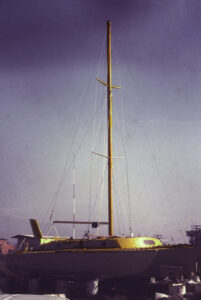
I was living on Spice off the wharf at Santa Barbara at the time, getting ready to sail up to Northern California where I had a job offer working for a sailmaker. Putting the new mast on in Ventura had been the last major step in getting ready for that trip. I just had to go back to Santa Barbara, provision the boat, pick up some of my stuff and say my goodbyes.
So we cast off and made our way out of the harbor. Because Spice didn’t have an engine and was just a pure sailing vessel, I always had two anchors ready to toss, one from each end of the boat, by just cutting a piece of 1/8″ cord or slipping a slipknot. Once at sea, I secured the anchors a lot more solidly, but anywhere near a harbor or jetties I kept my emergency brakes ready.
We got a little wind outside the harbor entrance, maybe eight knots, and I had Paul steer while I got the wrench and screwdriver out and tuned the rigging under load. I noticed there was a fairly big groundswell running, maybe 10-12 feet.
The wind picked up a little to 15 knots, so I sighted the mast again, then went around fine tuning the rig and was pretty happy with the result. This was good, becaust then the wind picked up a little more. It was blowing 18-20 knots now, and we were 7 or 8 miles out from Ventura harbor headed for Santa Barbara.
We were enjoying the day. It was beautiful and sunny, with a little overcast and some grey stuff off to the south. About halfway to Santa Barbara, the wind picked up again. This time it jumped straight to 30 to 35 knots in half an hour, then up to 40+ a little later. It got more overcast, and we started to get some windblown rain.
(Below) Spice in Hawaii off the Big Island, much later than this story. But we made it!
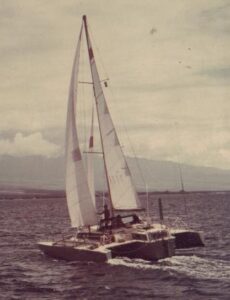
I put a double reef in the mainsail, keeping the staysail up, and dropped the yankee, tying it down really well, When I finished it was blowing 40 to 45+ solid, and I was really glad I had been conservative and put a double reef into the main instead of just one. The wind didn’t pick up any more, which was really fortunate. I only had two sets of reef points in that main, and no storm staysail yet.
As we got closer to the Santa Barbara wharf, I checked it out. It looked wrong. I got out the binocs for a closer look and all of a sudden I understood. The reason it looked wrong was that the waves were breaking over the end of the pier, which was 15 feet off the water, and the entire harbor entrance was closed out with 20-foot breaking waves. The harbor dredge had been pulled back inside the harbor for safety.
As I scanned the anchorage where I had been living on Spice, I recognized four of my friend’s boats high and dry on the beach. They had dragged anchor in the fast-building wind and swell and no one had been able to get out to them in time to get them to safety.
I realized it wasn’t going to change anytime soon. It was time to swallow that lump in my throat and start thinking about alternatives. Can’t anchor in an open roadstead in that kind of wind and swell; can’t surf through fifteen-foot breaking waves into a crowded harbor in 40 knots of wind without trashing my boat and probably others too.
I turned towards the Channel Islands to look for a safe anchorage there. We crossed back towards the other side of the channel from Santa Barbara. When we were about halfway to the islands it became obvious that the wind, which was clobbering the south side of the islands, was also wrapping around the islands into the channel and clobbering the anchorages on the north side. These anchorages were where I’d thought I’d find some shelter. That lump in my throat came back, bigtime.
When you have no choice but one, you still have that one. I was thinking really hard. I asked Paul if he didn’t mind going to San Francisco. He said sure, that sounded like fun. I think it was Tuesday and he said he didn’t have to be to work until Saturday. This was the first time he’d ever been sailing, you know, and he had no idea what I was asking him or what he was in for. Not that we had a lot of options.
We could have beaten out of the channel then hove to in the offshore shipping lanes in 45 knots, which would have been a lot of fun. Oh, I forgot to mention, besides not having an engine, the boat didn’t have an electrical system yet, nor running lights, nor any radio except the little Radio Shack weather radio that got the Coast Guard weather stations.
I had a flashlight, and Aladdin lamps in the cabins. I actually started to get a little excited, thinking about it. I had been planning to beat up the coast against the usual northwesterly headwinds in a week or so to get to my new job in San Mateo. Surfing north in a southerly instead of beating north in northwesterlies and getting the crap beat out of me sounded appealing.
I took stock of what we had for provisions: a 20-lb case of oranges, a 12-lb box of dates, some dry lentils and a good kerosene stove to cook them on (if we could keep the soup pot from flying off the top of the stove), half a loaf of bread, and two five-gallon plastic jugs of drinking water. By now it was about an hour from dark and we were just off Point Conception, the “Cape Horn” of the California coast.
I checked in with the weather on the little battery radio, and the nice Coast Guard man said it was blowing 45 knots south-south-east, and gusting, with seas 15 to 18 feet and building. The sumlog had been pegged at 15 knots for hours since we gave the pier at Santa Barbara a pass.
I looked around, and thought, with an hour to sunset, I should give the self-steering a try. I had used it for short runs in light winds and it had worked fine. I had built it just like Jim Brown said to in his Searunner Construction Manual. It oughta work, right?
Before I did that, I let Paul try steering. I wanted to see if there was any possibility of sleep besided the self-steering, or if I just had to stay up. I explained it to him: just like a car with a delay in the response. Paul immediately put us into a monster screaming broach down the face of a wave; he freaked out and froze, I freaked out and grabbed the wheel back.
OK, that wasn’t gonna work. Let’s try the self-steering. We had turned the corner at Point Conception a while back and were heading up the coast now, double-reefed mainsail and staysail up, and the waves were coming up from the stern quarter.
As a wave would come charging up behind us, the stern would get kicked sideways, I would frantically counter by spinning the wheel, the boat would catch the wave, put on an additional eight or ten knots for eight or ten seconds, and go charging up the back of the monster wave in front of us.
Then we would slow down a little, (but not enough to unpeg the sumlog), the next wave would come up behind us, and the whole thing repeated itself. Doing the best I could, and spinning the wheel madly the whole time, my expert human steering had us yawing thirty degrees to either side of my desired course.
Finally I cut in the self-steering. I didn’t disengage the rudder with the wiggler yet, as I was sure I would need to override the self-steering the way I had needed to override Paul. The wheel spun, driven by the ghost vane and trimtab on the stern of the boat, and the yaw reduced to fifteen degrees of either side of the course.
My hands hovered just above the wheel, lightly letting the rim spin under my fingers, ready to grab it to avert disaster if necessary. I felt the wheel turning when I wouldn’t have turned it; and it did things I wouldn’t have done if I was manually steering the boat. After about fifteen flawless minutes of this, I relaxed big time.
I got Paul up from below and gave him the lecture about watching for lights, watching the compass, etc. Paul was just stoked. He wasn’t seasick, and this was the most exciting new thing that ever happened to him. Paul was doing great! I couldn’t have asked for a more pliable or positive crew member.
Then, about thirty miles off the coast and maybe sixty north of Point Conception, I sacked out. I had been on watch manually steering the boat for sixteen hours. I had checked Paul out for the last couple hours on the red light/green light thing, we had seen ships, and we had seen a tugboat, so he knew there was something dangerous (and often invisible) behind them.
I felt pretty good about things. By now, we were in the middle of a dark, dark night, ripping along at twenty knots plus, roaring down the faces of these waves that had gotten quite a bit larger than what the Coast Guard proposed earlier in the day. We were stoned out of our minds, with no drugs or alcohol involved, just raw ocean energy.
You see, the entire surface of the sea had turned into a giant blue phosphorescent light show. There were the three huge tracks the boat left running up and down the surface of the waves, then the monster blue glow when six feet fell off the top of a 20-foot wave in the dark. There were little darting streaks of blue: fish, or squid, no way of telling.
Every once in a while, in a fleeting quiet moment between waves, a great blue whirl would occur twenty or thirty feet below the surface when something down there did something down there. This made me hope our 3/8″ thick plywood boat didn’t look or sound like food.
I got a couple of hours of much-needed sleep inside a boat that sounded like it was parked under a 100-foot waterfall, then got up for a half hour and checked out the scene. Pretty much like when I went to bed: fast, wet, phosphorescent, and unearthly. I went back to bed for another four hours with no alarms from Paul, checked again, and noticed the wind had dropped to a measly 40 knots or so. I went back to bed; we blasted on through the night. At sunrise, we were in the middle of a trackless mess of big confused waves, surfing north with the sumlog still pegged.at fifteen knots.
I had no idea where we were. Although I was a navigator and had even taught courses in navigation, without a horizon I couldn’t do anything. We hadn’t seen that since Santa Barbara, nor could we see land or any ships. I mean, I had my dead reckoning, for what that was worth. We had been going for how long (I knew that). At what speed I had no idea, since my speed measuring device had pegged eighteen hours ago, stayed that way since then, and was now making whining noises. In what direction (I had a general idea of this, with the side-to-side yaw reduced to a total of only thirty degrees by the self-steering, instead of the 60 degrees we were doing when I was hand steering).
I took out my pencil and put a dot on the chart just a little north of the Big Sur coast, somewhere between twenty and ninety miles offshore, then tried to figure out a course to set, since the wind and waves seemed to be abating. We headed in towards the coast a little more and ran like that until nightfall.
As sunset approached the wind dropped and dropped and dropped, until we were flopping like mad in the leftover confused swell from the southerly with about three knots of wind. I unlashed the yankee again and hauled it up, shook the reefs out of the main, and kept on. The sea got quieter and quieter, until about three in the morning, we were sitting in a flat calm, fogbound, with the sails slatting back and forth. We had made it to somewhere; we weren’t sure where. We had seen no lights all night, neither ships nor lighthouses.
We flapped all the next day. This is where you guys with engines would have fired them up and gone somewhere purposefully to figure out where you were. With no engine, I, the navigator, had a fogbound day with no horizon, no ships to clue us we were near a shipping lane, and no shoreline. No nothing. We found out we didn’t have any kerosene for the stove after all, so we ate oranges and dates and farted a lot: they’re not a good food combination.
We flapped on into the night. At about ten that night, we got a nice steady three-knot breeze, which seemed huge after the day and night we had just spent flapping. It was really pleasant sailing. And then, about two, we started seeing lights off the land. Just an occasional flash here and there, nothing that could possibly be a lighthouse.
Then, I started seeing a regular flash. I timed it by counting Mississippi-one, etc (I had no stopwatch or timepiece). I got fifteen seconds, then eighteen, then fifteen (or was it sixteen?) then twenty-eight. Was that double fifteen, or sixteen, cause I missed seeing a flash? Then twenty-one seconds; not double anything. What the heck? I combed the charts and racked my brains, and tried every combination of things I could think of to make this lighthouse make sense with no luck.
Then the light dawned on me (literally). I had driven this coast before, and what I was seeing was a coastal access road that opened onto the coast highway by coming up a slight rise before the turn onto the highway at Pescadero. I had been seeing the flash of the headlights when the cars turned onto the highway, every fifteen (or twenty-one) seconds. You couldn’t see the car lights until they turned, because the road was in a depression all the way to the coast. I knew exactly where we were.
We had a beautiful sunrise. The fog lifted, we were twelve miles from the harbor at Pillar Point, Half Moon Bay. It took us until noon to make those twelve miles, Then I slept for days and days. Paul hitchhiked home to Santa Barbara, and I never saw him again.
Fair Winds, Tim